

How to have a conversation without hurting the other person?
One of the most important tools for influencing reality is language. It forms culture, is essential for communication, and helps people define and present themselves. It can be used to maintain or prevent stereotypes and prejudices. For this reason, it is necessary to use words and phrases that are not perceived as demoralizing or offensive. What is equality language? How should it be used?
Our language is constantly evolving. It is nothing more than an encouragement! However, it is worth realizing that in addition to the enthusiasts of this process, there are also opponents of it. Some believe that expanding the vocabulary is a waste of time and even causes a lot of confusion in society. Anyone can use certain expressions that sound negative and are unacceptable in use. They usually refer to our appearance, national affiliation, religion, sexual orientation and so on. Name variations can also strongly irritate or frustrate. Words have weight and can significantly hurt another person, we are all aware of this.
It is worth realizing that the use of inclusive language not only promotes the fight against stereotypes, but also helps ensure the safety of people belonging to particular social groups. Memorizing a few new words is not difficult, yet it can create positive feelings in a potential interlocutor.
Examples of the use of equality language
Equality language includes a number of responsible and polite verbal phrases. They make it possible to specify background, age, gender, illness and other factors. Such words change our speech in a way that doesn’t sound aggressive to others. I have prepared a series of recommendations on the appropriate form of communication with members of certain social groups.
1. Elderly people
Let’s start with people who unequivocally deserve respect. We usually perceive that this group includes all people over the age of 60. After all, how should you dialogue with members of this age group?
- Don’t talk about older people in a one-sided way. The elderly are often portrayed as weakened, sick, dependent on help or hermits, which is unfair discrimination against them. Moreover, it can contribute to negative attitudes toward old age in society. Many retirees are active, earning and engaged in social activities. Don’t think of them only in terms of pensions and health problems.
- Show respect, emphasize authority, avoid ridicule, let the elderly feel that they are wise and experienced people.
- Don’t mention the person’s age unnecessarily. Age is not an indicator of a person’s interests, mental and physical abilities, or activities. Do not discuss information about a person’s age unless it is really justified.
2. Sexual orientation
Such terms as „sex” and „gender” describe sexuality from different sides, the latter not being an ideology.
Sex – a term for a set of psychological, biological and cultural characteristics that are classified as feminine or masculine.
Gender – the manifestation of feminine or masculine nature in accordance with cultural postulates formed within a given society.
- It should not be claimed that therapy can change someone’s sexual identity. What is not a disorder or disease cannot be treated! Historically, conversion therapy has humiliated and harmed participants rather than helped and supported them. Such practices can be even called pseudo-scientific experiments.
- Do not try to judge homosexual or heterosexual relationships. Refrain from giving advice on the good of the relationship. Judging what is best for another couple is not within your competence.
- Refrain from vulgarities that may offend or insult the person in question, as well as from words indicating that homosexual relations are something unnatural. Do not succumb to the stereotypical view that it is normal for people in same-sex relationships to have more than one partner or partners.
Use such words as:
Gay, lesbian, gay person, bisexual person, transgender person, same-sex couple, etc.
Avoid:
Homosexual, transgender, transsexual, pervert, etc.

3. Health and one’s ability
Today, the language of psychiatry does not use words such as crazy, schizophrenic, depressive, bipolar, saying instead a person/patient with a diagnosis of schizophrenia. Why using such long and complicated phrases? Because interpreting „schizophrenic” and the like limits a person in the dimension of his illness, while they may be an outstanding musician, a talented planter, someone’s partner, child. By giving up the use of words that have a radical meaning, we protect such people from the stigmatizing effect.
Importantly, there is a significant difference between the expressions „disabled person” and „person with a disability.” In the first case, it happens similarly to the situation with the aforementioned „schizophrenic.” A frame is created around the individual that is restrained in their disability. A particular person’s speech defect does not define who they are. In addition to being a „person with a speech defect,” they may be a talented painter, a book author, a citizen of his country or a cyclist. And all this with a speech defect! A person with a disability means that this person has some attribute that does not define them as a person. Be careful what you talk about with people with disabilities. When disability becomes the main topic of conversation, it can damage a person’s self-esteem.
- Do not exalt the merits of people with disabilities. Don’t call them brave and special for doing ordinary things. Would it be so interesting if they didn’t have a disability?
- Don’t use terms like „tragic victim.” This may be perceived by others as an insult.
- When communicating with a person with a disability, speak directly to them – not to their caregiver, mother, or father.
Avoid:
Cripple, invalid, blind, confined to a wheelchair, wheelchair-bound, incapable, inept, person with special needs, etc.
4. People from another country and culture
Inclusive language is also important when talking about people from other countries and cultures. When addressing this social category, use the following colloquial phrases:
- Words that directly speak of origin – Chinese, Italian, Ukrainian, etc. If the nationality of the person is not known, it is possible to laconically describe his skin color, for example, you can use „a black person.”
- Migrant, immigrant, emigrant – a term referring to people who have changed their place or country of residence.
- Refugee – a term for people who have been forced to leave their country, such as a result of war or persecution.
- Jew, Jewess – a neutral term for people of Jewish nationality.
Avoid:
Refugee wave, invasion, black, yellow, Negro, etc.
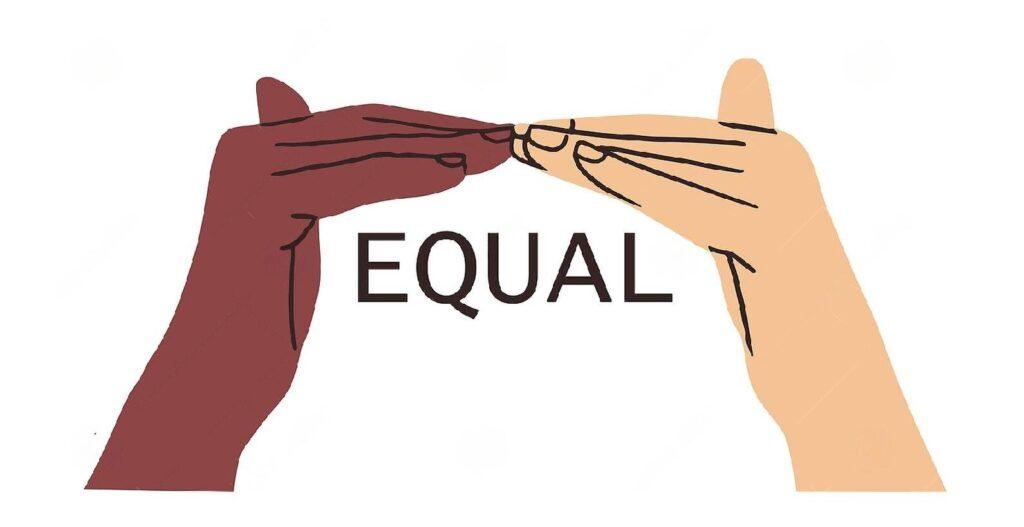
Language of equality as a basis for communication
Our society is rapidly evolving, which means we are conscious of the words and expressions we speak. Using inclusive language is not only a way to communicate politely, but can also make the speaker smile and feel accepted as a member of society.
Through this approach to communication, we bring socially important issues to the attention of the audience. In addition, we prevent the spread of stereotypes. Delve into all the details and nuances of language, because through it we are creating new chapters in history and evolution.
Recommended literature:
- https://www.pfron.org.pl/fileadmin/files/0/477_01-Dariusz_Galasinski.pdf/ (Dariusz Galasiński – “Osoby niepełnosprawne czy z niepełnosprawnością?”), viewed: 23 stycznia 2023 (Disabled or people with disabilities?)
- Beata Maciejewska – “Jak pisać i mówić o dyskryminacji. Poradnik dla mediów”, wyd. Stowarzyszenie Inicjatyw Niezależnych “Mikuszewo”, Mikuszewo 2007 (How to write and speak about discrimination. A guide for people working in media)
- Andrzej Zybertowicz – “Przemoc i poznanie: studium z nie-klasycznej socjologii wiedzy”, wyd. UMK, Toruń 1995 (Violence and cognition: a study in the non-classical sociology of knowledge)
Translated by: Nadia Listopadska